Blog

May 17, 2026

5 min read

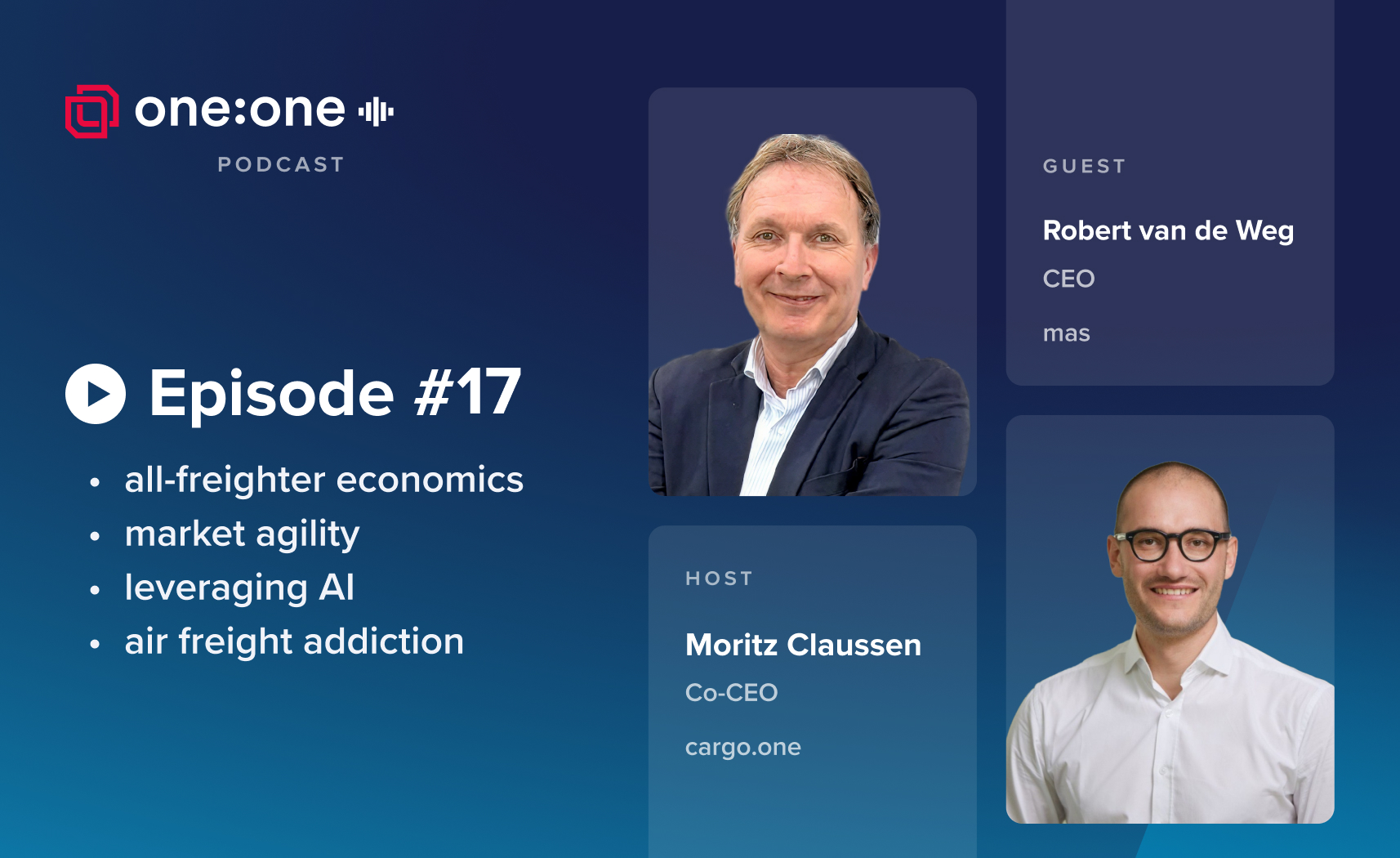
Episode 17 of cargo.one:one ft. Robert van de Weg, mas

No items found.

In our popular podcast series, cargo.one Founder & Co-CEO Moritz Claussen hosts candid chats with visionary leaders from the logistics world, uncovering their formative experiences and most valuable advice. Subscribe today!

cargo.one:one returns with an air freight industry veteran with more than 35 years experience across air logistics – Robert Van De Weg, CEO of Mexican carrier mas. Within senior roles at the global carriers KLM Cargo, Atlas Air, Cargolux, and AirBridgeCargo, as well as GSAs and technology providers, he has amassed a huge knowledge base to share with us.

Robert grew up in the rural north-east of the Netherlands, a long way from any airport and with no particular interest in aviation. However, as a student Robert was certain that he wanted an international career. After studying business administration in Rotterdam, he pursued opportunities that would send him abroad. 

Upon interviewing at KLM, a chance discussion with the manager responsible for KLM’s trainee programme steered him toward the fast-growing cargo division. Having been told: “You can always change back. It’s very easy to move from one division to the other”, Robert jokes that this was never going to be the case. He was soon posted to Singapore as Regional Manager, then to Dubai as Director.

Developing commercial muscle

Robert admits that the sheer number of senior industry figures who came through KLM Cargo – including Jan Krems, Kirsten de Bruijn. Michael Steen – is difficult to see as a coincidence. Behind this track record was a deliberate strategy “to build a much bigger KLM Cargo” and “really become a logistics player.”

Enjoy the full length episode, here:

While KLM Cargo had ambitions to acquire a freight forwarder and compete directly with shippers, it would not be the case: “The forwarders had already really solidified their position in the supply chain.” Many of the big talents from that era were absorbed into the industry and Robert’s own exit took him into full-freighter territory – first with Atlas Air, and then a decade split between Cargolux and AirBridgeCargo.

At a combination carrier, cargo contributes roughly 20% of revenue while sharing a cost base built around the passenger operation. The network decisions, however, are nearly always driven by passenger logic. Robert admits, moving to a pure-play freighter carrier stripped away that safety-net and required learning revenue management lessons fast.

“In a cargo airline, there’s no escape. You need to make money and you need to understand your costs.”     Robert van de Weg

Agility always tested

Working without the security of passenger revenue also handed him something valuable and new – complete autonomy. Today, Robert has brought the same empowerment and entrepreneurial instinct to mas. The airline runs a deliberately flat structure. Its commercial, maintenance, and flight ops teams share the same open-plan office in Mexico City. If a fuel supply issue hits a station or an interesting window of commercial opportunity opens, Robert can deploy the right talent decisively and with speed: “This is our advantage as a small airline and we need to make full use of that.”

That flexibility has been well tested. Air freight pricing was once relatively stable, and the rate swings of the magnitude seen in recent years would have seemed extreme a decade ago. Robert points to COVID as the event that permanently reset expectations across the market: “The COVID times really drove the paradigm shift, the market is now used to much more extreme volatility.” Indeed, airlines have had to keep pace: “The short-term revenue management function of airlines has professionalized a lot in terms of dealing with supply-demand. This was unthinkable 15-20 years ago.”

“You can really determine your own destiny as a cargo airline. In a passenger airline, you’re always going to be, to an extent, a by-product.”      Robert van de Weg

Becoming Chief Commercial Officer at ECS Group in 2019, Robert could bring his deep affinity with airline needs to the GSA model. He believes that their capabilities are still too often underestimated in the industry: “The level of professionalism in these companies is very high," he says. "And it's an essential function in the supply chain.” He points to the broad range of capabilities that the rather neutral term ‘GSA’ does not do justice to nowadays – including commercial strategy, market coverage, digital capability, and deep customer relationships across dozens of markets. He concludes: “Maybe it's the word that should change”.

Strategic digitalization

Robert has always been a strong believer in digital transformation. While at AirBridgeCargo, his team was among cargo.one's earliest customers, early movers on the shift to digital quoting and booking that would reshape how freight is bought and sold today. At mas, that same strong ambition is being applied to AI across several fronts.

Customer service and quoting is the first target – using AI to draft responses so frontline staff spend their time analyzing and approving rather than composing quotes from scratch: “The key thing is to use the brain power more where it's best suited”. A revenue management project is also underway, applying AI to pricing decisions with more flexibility than older systems could manage. Robert underpins successful AI adoption with the key principle: AI prepares, the human decides. In this way, the anxiety that often surrounds AI adoption in frontline teams stays manageable.

“The human stays in control. AI can support preparing answers, messages, contents — but the one that pushes the button is the human.” Robert van de Weg

After 35 years, Robert’s air freight muscle is stronger than ever. Aside from the odd bump from volatility, he remains upbeat about the long term trajectory of the industry. Is Robert’s career more evidence of the addictive nature of air logistics? Robert emphatically agrees: “Yes, I think so! "If you're used to the world being your playground, it will be very hard to work in a more regional or local context."

What aspect of market dyamics does Robert view as a shame and wasted opportunity? Tune into Episode 17 now to find out! 🤩

cargo.one:one features many more exciting guests in the series. If you enjoyed this episode, stay tuned to our blog or subscribe using your favorite podcast platform including Spotify, Apple podcasts, Amazon Music, iHeartRadio, Castbox and more.

Share this article

Lead the way with cargo.one

Stand out from the competition and grow your business with cargo.one

Episode 17 of cargo.one:one ft. Robert van de Weg, mas

Published
May 17, 2026

cargo.one:one returns with an air freight industry veteran with more than 35 years experience across air logistics – Robert Van De Weg, CEO of Mexican carrier mas. Within senior roles at the global carriers KLM Cargo, Atlas Air, Cargolux, and AirBridgeCargo, as well as GSAs and technology providers, he has amassed a huge knowledge base to share with us.

Robert grew up in the rural north-east of the Netherlands, a long way from any airport and with no particular interest in aviation. However, as a student Robert was certain that he wanted an international career. After studying business administration in Rotterdam, he pursued opportunities that would send him abroad. 

Upon interviewing at KLM, a chance discussion with the manager responsible for KLM’s trainee programme steered him toward the fast-growing cargo division. Having been told: “You can always change back. It’s very easy to move from one division to the other”, Robert jokes that this was never going to be the case. He was soon posted to Singapore as Regional Manager, then to Dubai as Director.

Developing commercial muscle

Robert admits that the sheer number of senior industry figures who came through KLM Cargo – including Jan Krems, Kirsten de Bruijn. Michael Steen – is difficult to see as a coincidence. Behind this track record was a deliberate strategy “to build a much bigger KLM Cargo” and “really become a logistics player.”

Enjoy the full length episode, here:

While KLM Cargo had ambitions to acquire a freight forwarder and compete directly with shippers, it would not be the case: “The forwarders had already really solidified their position in the supply chain.” Many of the big talents from that era were absorbed into the industry and Robert’s own exit took him into full-freighter territory – first with Atlas Air, and then a decade split between Cargolux and AirBridgeCargo.

At a combination carrier, cargo contributes roughly 20% of revenue while sharing a cost base built around the passenger operation. The network decisions, however, are nearly always driven by passenger logic. Robert admits, moving to a pure-play freighter carrier stripped away that safety-net and required learning revenue management lessons fast.

“In a cargo airline, there’s no escape. You need to make money and you need to understand your costs.”     Robert van de Weg

Agility always tested

Working without the security of passenger revenue also handed him something valuable and new – complete autonomy. Today, Robert has brought the same empowerment and entrepreneurial instinct to mas. The airline runs a deliberately flat structure. Its commercial, maintenance, and flight ops teams share the same open-plan office in Mexico City. If a fuel supply issue hits a station or an interesting window of commercial opportunity opens, Robert can deploy the right talent decisively and with speed: “This is our advantage as a small airline and we need to make full use of that.”

That flexibility has been well tested. Air freight pricing was once relatively stable, and the rate swings of the magnitude seen in recent years would have seemed extreme a decade ago. Robert points to COVID as the event that permanently reset expectations across the market: “The COVID times really drove the paradigm shift, the market is now used to much more extreme volatility.” Indeed, airlines have had to keep pace: “The short-term revenue management function of airlines has professionalized a lot in terms of dealing with supply-demand. This was unthinkable 15-20 years ago.”

“You can really determine your own destiny as a cargo airline. In a passenger airline, you’re always going to be, to an extent, a by-product.”      Robert van de Weg

Becoming Chief Commercial Officer at ECS Group in 2019, Robert could bring his deep affinity with airline needs to the GSA model. He believes that their capabilities are still too often underestimated in the industry: “The level of professionalism in these companies is very high," he says. "And it's an essential function in the supply chain.” He points to the broad range of capabilities that the rather neutral term ‘GSA’ does not do justice to nowadays – including commercial strategy, market coverage, digital capability, and deep customer relationships across dozens of markets. He concludes: “Maybe it's the word that should change”.

Strategic digitalization

Robert has always been a strong believer in digital transformation. While at AirBridgeCargo, his team was among cargo.one's earliest customers, early movers on the shift to digital quoting and booking that would reshape how freight is bought and sold today. At mas, that same strong ambition is being applied to AI across several fronts.

Customer service and quoting is the first target – using AI to draft responses so frontline staff spend their time analyzing and approving rather than composing quotes from scratch: “The key thing is to use the brain power more where it's best suited”. A revenue management project is also underway, applying AI to pricing decisions with more flexibility than older systems could manage. Robert underpins successful AI adoption with the key principle: AI prepares, the human decides. In this way, the anxiety that often surrounds AI adoption in frontline teams stays manageable.

“The human stays in control. AI can support preparing answers, messages, contents — but the one that pushes the button is the human.” Robert van de Weg

After 35 years, Robert’s air freight muscle is stronger than ever. Aside from the odd bump from volatility, he remains upbeat about the long term trajectory of the industry. Is Robert’s career more evidence of the addictive nature of air logistics? Robert emphatically agrees: “Yes, I think so! "If you're used to the world being your playground, it will be very hard to work in a more regional or local context."

What aspect of market dyamics does Robert view as a shame and wasted opportunity? Tune into Episode 17 now to find out! 🤩

cargo.one:one features many more exciting guests in the series. If you enjoyed this episode, stay tuned to our blog or subscribe using your favorite podcast platform including Spotify, Apple podcasts, Amazon Music, iHeartRadio, Castbox and more.

Download Photos

Join hundreds of freight forwarding companies already using cargo.one.

Get started
Testimonials

Clients About Us

“If you end your training now, if you choose the quick and easy path, as Vader did, you will become an agent of evil.”

Lizzie Moore — Zapier

“If you end your training now, if you choose the quick and easy path, as Vader did, you will become an agent of evil.”

Leroy Sims — Apple

“If you end your training now, if you choose the quick and easy path, as Vader did, you will become an agent of evil.”

Leo Mack — Webflow

“If you end your training now, if you choose the quick and easy path, as Vader did, you will become an agent of evil.”

Claudia Davidson — Shopify

“If you end your training now, if you choose the quick and easy path, as Vader did, you will become an agent of evil.”

Victoria McCoy — Google

“If you end your training now, if you choose the quick and easy path, as Vader did, you will become an agent of evil.”

Steve Richardson — Dribbble