

A note from the author
I have spent over a decade building rate management and quoting solutions for freight forwarders, first as Co-founder & CEO at Cargofive, and now as VP Ocean at cargo.one. In that time, I have watched the market move from fax to email to booking portals, and now to AI.
This shift feels different from the earlier ones. The UI has stopped coming up as a concern. The forwarders asking the sharpest questions want to know how to make their rate data machine-readable, how to open up APIs and MCP servers so other systems can query them, and whether their AI can learn from six months of their own quoting patterns.
— Sebastian Cazajus, VP Ocean at cargo.one
1. What is changing
Freight forwarding is going through a structural change. Quote volumes are rising and the window to answer has collapsed. Where a shipper once waited a day for an email reply, today the forwarder who answers within the hour takes the business.
That window is about to shrink again, because shippers are adopting AI just like everyone else. Before long, the request will not come from a person at all but from one system querying another, expecting an answer in seconds and arriving in volumes no human desk would ever generate. That is not the same job done faster. It is a different job: answer quickly, answer correctly, and still hold the margin, on the buy side and on the cost to serve.
On paper this should already be solved. Everyone has access to the same powerful AI models, and anyone can wire up an agent over a weekend. The challenge sits in the integration and in the data that feeds it. On the data side, it is not one missing surcharge but the whole structure: every applicable charge, correctly mapped, current for the trade lane and the week, and complete enough that the total on the quote is the total the shipment actually costs. On the integration side, the model has to be wired into the pricing logic itself: the margin rules by customer and lane, the carrier allocations, the thresholds that decide when a quote goes out untouched and when a human should see it. That is what separates a system a pricing team can stand behind from a black box that produces a number nobody can explain or correct. Get either wrong and the forwarder has lost the deal or won it at a price that costs money. At machine speed that happens before anyone can catch it, and across enough quotes that the damage only surfaces when the month closes.
And the rates are only part of it. The pricing rules, the carrier preferences and the operating knowledge in people’s heads feed the same system. Where all of that is in place, the AI part is straightforward. Where it is not, no model can make up the difference.
2. Why AI, and why now
Every industry has its early adopters. Three or four years ago, the forwarders who asked us for innovation wanted a clean portal and meaningful automation in their workflows. Today, the same people ask whether an AI worker can do the work itself: a system that takes over the repetitive steps while the team supervises and spends its time on complex shipments, rare routings and the customers who matter most. How much it runs on its own is for each forwarder to decide.
We built cargo.one on the conviction that the data has to be right before the AI goes in. The market evidence supports it: McKinsey found in 2025 that 88% of organizations run AI in at least one function, and only around 6% see a meaningful financial return. No model closes that gap. An AI worker cannot quote without structured rates, book without carrier integrations, or judge the right margin without knowing the customer.
What gets less attention is what that data layer makes possible once it exists, because from that point the advantage compounds.
3. Commercial intelligence is the part nobody can copy
On day one, a quoting agent is generic. It knows freight, but it does not know your freight. Six months and a few thousand quotes later, it has built something close to intuition. It knows that this customer pushes back on transit time, that this lane needs a buffer on the surcharge, that this rate level wins the deal and that one loses money. A procurement agent goes through the same evolution: it learns which carriers honor their allocations, which co-loaders come back with a better number when asked twice, and when asking twice is worth the time.
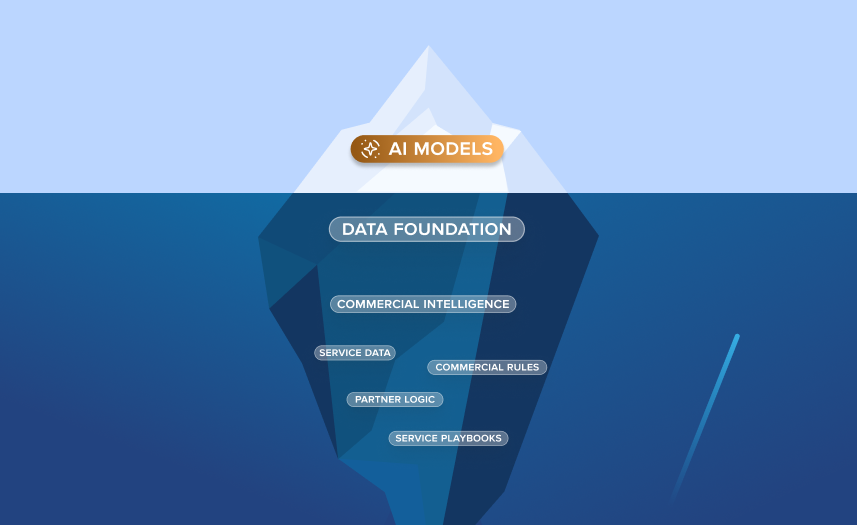
We call the substance behind that learning ‘commercial intelligence’. Four layers make it up, and none of them can be prompted into existence:
- Service data, with real depth and breadth. Not just a rate sheet. Validated, structured, current pricing across carriers, schedules, lanes and surcharge structures.
- Commercial rules. How a forwarder treats each customer tier, when premium beats economy, which margins apply to which accounts, lanes and volumes.
- Partner logic. Which carriers and co-loaders they favor on which trades. This sits on allocations and years of reliability history, and today most of it is scattered across the team’s heads.
- Service playbooks. When to propose consolidation, how to handle exceptions, and everything the operations team knows about which routings actually hold up.
Together these turn a generic AI worker into your AI worker. How the agent works matters as much as what it reads: the prompts, the checks, the order of steps, the rules for when it escalates to a human. Designing that well is specialist work, and it compounds the same way the data does.
Where this intelligence lives matters as much as whether it exists. A separate tool running beside the operation, fed by an overnight export, always describes the business as it was yesterday. The intelligence has to sit in the system where the work happens, and new data has to reach it as it arrives, so the AI prices against the market as it stands rather than as it stood at the last refresh.
Every quote it handles sharpens the next. It sees which quotes converted and at what margin, which lost and by how much, which lanes ran thinner than expected, and it prices the next one accordingly. Across cargo.one’s own production traffic, tens of thousands of AI-generated quotes a month, eight in ten go out without anyone touching them, and the time per quote has fallen from around fifteen minutes to under one. A competitor can deploy the same AI worker tomorrow. They cannot deploy the twelve months of your quoting patterns that trained it, or six, or even three. The more of the shipment it handles end-to-end, the faster that gap widens.
THE OCEAN REALITY
Ocean is the hardest version of this. Pricing runs across multiple equipment types, service types and commodities, with surcharge structures that shift by trade lane and by week. One missing PSS or one mismapped equipment surcharge turns a winning quote into a loss, and the AI stumbles on the first real request it sees.
Rate ingestion is the first test, and everything else depends on it. Early on, a meaningful share of the rate data we processed needed human review, because accuracy was not high enough to trust the system on its own. As it processed more carrier templates and more of the variations this market produces, that share fell steadily. It learned which templates it could trust, which surcharge logic applied where, and when to stop and flag something. QA has not disappeared, but it takes far less of it than it used to. Volume and time drove that improvement, not a bigger model. Our ocean layer now holds millions of NAC, spot and FAK rates with direct carrier connections.
4. What good looks like, and how to get there
The forwarders in the best position have done one thing well: they hold their pricing and service data in one solid layer, and they are now building on top of it. Some built that layer themselves over years. Others work with a partner who makes it accessible, either as a platform their teams work in or as an API and MCP layer they build their own tools on. Both routes work. What does not work is assuming a capable model will cover for data that is not there.
For those not there yet, the first priority is to get global pricing into a machine-readable, unified layer that covers every service sold, every mode operated and the nuances customers care about. Four things I would do:
- Treat commercial intelligence as a commercial asset, not an IT project. Capturing it, structuring it and keeping it current is the core work of the next decade in freight forwarding, and it belongs to whoever owns pricing.
- Get the pricing engine right before the AI. An accurate quote sent by email beats a wrong quote delivered by a chatbot. Fix the content, then automate the delivery.
- Become machine-accessible. Increasingly the customer’s AI will ask for the quote, not the customer. APIs, MCP servers and structured access keep a forwarder in the consideration set.
- Start now. The learning only begins once the system runs against live deals, and it cannot be backdated. A forwarder who starts this quarter will be a year ahead of one who starts next year, on the same technology.
5. Where this is heading
The forwarders winning a year or two from now treat commercial intelligence as part of the foundation rather than something added on top. Clean, structured data flows through every process. Every quote sent and every lane priced feeds back and sharpens the system. Pricing adjusts as the market moves. A rate request lands from Shanghai overnight and is quoted, chased and half-negotiated before anyone in Europe wakes up.
These are the forwarders where a 100-person team competes with a multinational of thousands, because they run a different operating model. Once AI workers handle routine quoting, procurement and booking, the team’s time moves to complex shipments, strategic accounts and new business. More business development brings more requests, and the AI turns those into quotes and shipments without adding cost. A forwarder on the traditional model scales by hiring. One on this model does it with every quote the system handles.
If you'd like to talk through what this looks like for your operations, get in touch.